
Weekly Market Insights
October 2, 2026 Volume 13 Issue 38
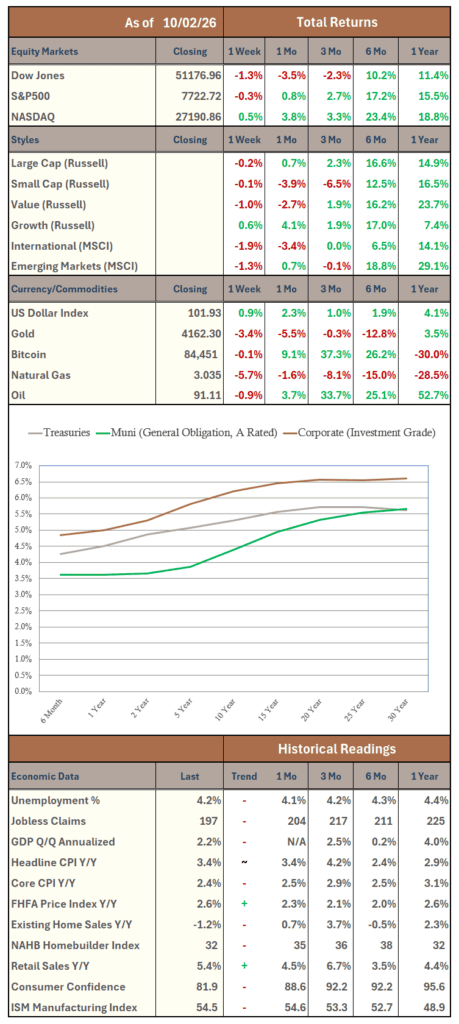
Growth stocks led U.S. equities, especially mid-caps. Technology far outperformed other sectors, followed by energy; healthcare and financials lagged. Emerging markets outperformed developed markets, though both fell modestly. Fixed income favored shorter maturities and investment-grade corporates over high yield, with the Treasury curve generally upward sloping. Sugar gained nearly 6%, while corn and silver had the steepest losses. Bitcoin was mostly flat.
Beneath those market moves, economic growth remained resilient, but labor conditions softened. Low unemployment masked a tougher job market, as slower hiring lengthened searches and limited opportunities for people seeking new positions. Inflation added another strain. August core PCE rose 3.0% year over year, though measurement changes complicated the reading. Average hourly earnings matched that 3.0% pace, sharpening concerns about household purchasing power.
Softer hiring and persistent inflation divided Fed officials on further tightening. Williams and Jefferson favored gathering data after September’s hike; Williams saw no need to rush. Logan urged another 50 basis points to curb stubborn inflation. Weak payrolls bolstered expectations of an October pause, though a year-end hike remained possible. Markets priced in only about 19 basis points of December tightening.
Geopolitical tensions added risk. Goldman Sachs said Middle Eastern crude exports recovered to about two-thirds of prewar levels as Saudi Arabia increased Strait of Hormuz shipments. Iran loaded no crude in September amid a U.S. naval blockade, keeping Gulf supply well below prewar volumes. Damaged refineries and high transport costs constrained fuel supplies, while diesel shortages increased freight costs and widened inflationary pressures. Meanwhile, heavy AI investment and government borrowing intensified competition for capital, prompting corporate issuers to reconsider bond timing and maturities.
Have a great week!
The data and commentary provided herein is for informational purposes only. No warranty is made with respect to any information provided. It is offered with the understanding that Hilltop Holdings Inc., PlainsCapital Corporation, Hilltop Securities and PlainsCapital Bank (collectively “PCB”) are not, hereby, rendering financial and/or investment advice, and use of the same does not create any relationship with PCB. This is neither an offer to sell nor a solicitation of an offer to buy any securities that may be described or referred to herein. PCB does not provide tax or legal advice. Please consult your own tax or legal advisor regarding your specific situation. Whether any of the information contained herein applies to a specific situation depends on the facts of that particular situation. Investment and estate planning and management decisions may have significant financial consequences and should be made only after consulting with professionals qualified to offer legal, accounting and taxation advice. Neither this document nor any portion of its content’s supplements, amends or modifies any account agreement with PCB. Unless otherwise noted:
*All economic release data referenced from public sources believed to be accurate. *The source of data for all charts/graphs included in this presentation is Bloomberg LP. *Figures quoted represent monthly changes (m/m) and are seasonally adjusted.